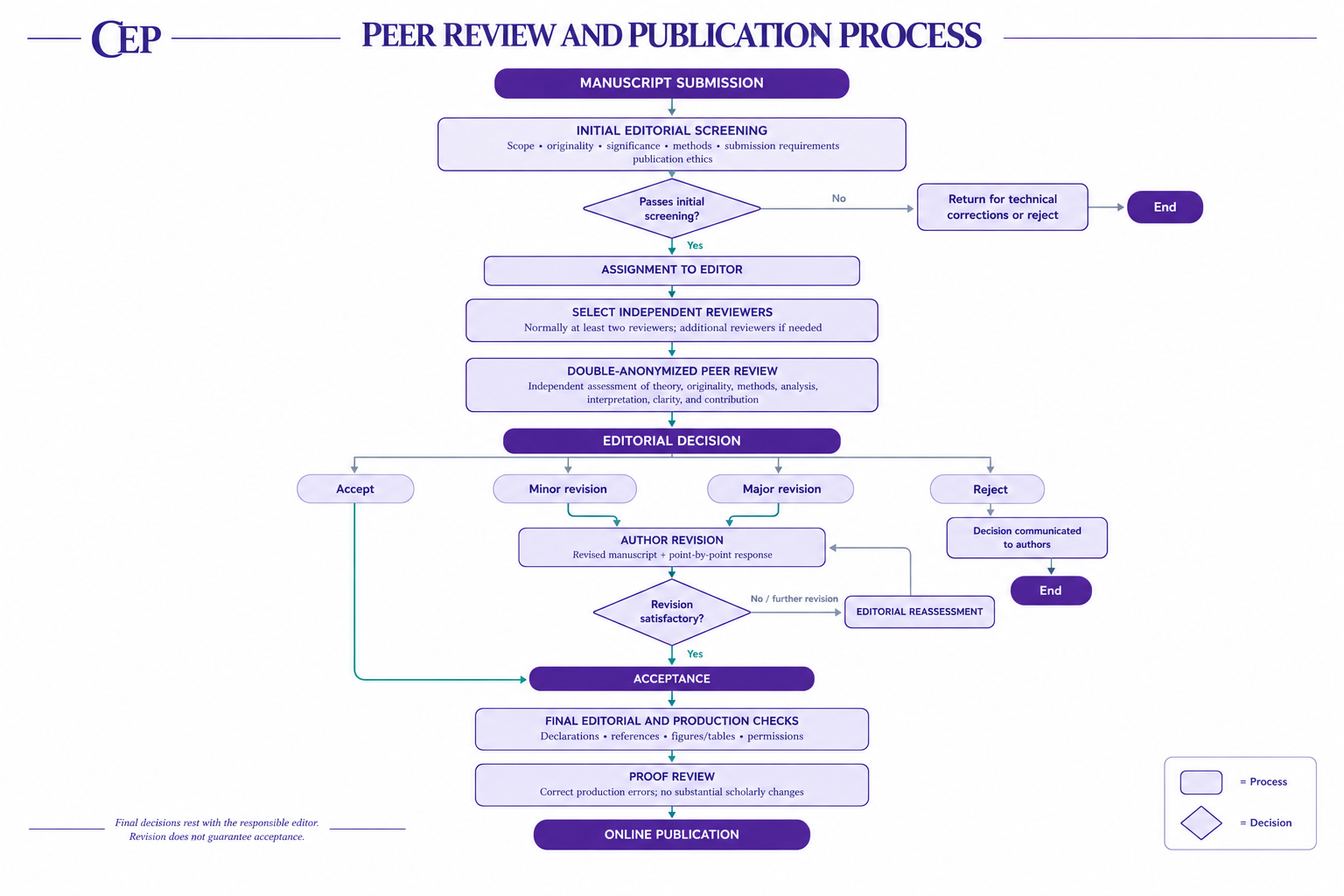
Cognitive Educational Psychology (CEP) operates a double-anonymized peer review process, in which the identities of authors and reviewers are concealed from one another throughout the review process.
Upon submission, each manuscript undergoes an initial editorial assessment to determine its alignment with the journal’s aims and scope, originality, scholarly significance, methodological appropriateness, and compliance with the journal’s submission requirements and publication ethics policies. Submissions may be returned to authors for technical corrections or rejected at this stage if they fall outside the journal’s scope, do not meet its basic requirements, or are not considered suitable for further consideration.
Manuscripts that pass the initial screening are assigned to an appropriate editor. The editor identifies independent reviewers with relevant subject expertise and without disqualifying conflicts of interest. The journal normally seeks reports from at least two independent reviewers. Additional reviewers may be invited when necessary.
Reviewers evaluate the manuscript’s theoretical contribution, originality, methodological rigor, analytical procedures, interpretation of findings, clarity of presentation, and contribution to cognitive and educational psychology. Reviewers are expected to provide objective, constructive, and confidential assessments. Authors must ensure that the main manuscript and any associated files intended for review do not reveal their identities.
The responsible editor considers the reviewers’ reports alongside an independent assessment of the manuscript. Possible decisions include:
Accept: The manuscript is accepted for publication, subject to any applicable final checks.
Minor revision: Limited changes are required before a further editorial assessment.
Major revision: Substantial changes are required before the manuscript can be reconsidered.
Reject: The manuscript is not accepted for publication.
The journal may use other decision wording where appropriate. A request for revision does not guarantee eventual acceptance. The final decision rests with the responsible editor and is based on the manuscript’s quality, relevance, ethical compliance, and scholarly contribution.
When revision is invited, authors should submit a revised manuscript and a point-by-point response explaining how each reviewer and editor comment has been addressed. If a suggestion is not adopted, authors should provide a clear justification. Revised manuscripts may be returned to the original reviewers or assessed by the editor, depending on the nature of the requested changes. Further rounds of revision may be requested when necessary.
Following acceptance, the manuscript proceeds to final editorial and production checks. These may include verification of required declarations, references, figures, tables, permissions, and other publication requirements. The article is then prepared for publication, and authors may be asked to review the proofs and report any production errors. Proof review is intended to identify errors and does not normally permit substantial changes to the accepted scholarly content.
After the final production checks are completed, the article is published online in accordance with the journal’s publication procedures. Publication metadata and the final article files are made available through the journal’s website.
Editors must disclose and appropriately manage any actual or potential conflicts of interest involving a submission. Editors do not make editorial decisions on their own manuscripts or on submissions in which they have a personal, professional, or financial interest that could compromise impartiality. Such manuscripts are handled by an appropriately designated, independent editor who is not conflicted and who follows the journal’s standard editorial and peer review procedures.
Reviewers must also disclose relevant conflicts of interest and decline invitations when they cannot provide an impartial assessment. Editorial decisions must be based on scholarly merit and the journal’s policies, independently of commercial, institutional, or personal considerations.
Manuscripts under review, reviewer identities, and review reports are treated as confidential, subject to the journal’s applicable policies and legitimate publication-ethics procedures. Editors and reviewers must not use unpublished information obtained through peer review for personal advantage or disclose it to unauthorized individuals.
Authors who wish to challenge an editorial decision may submit a reasoned written appeal to the editorial office. The appeal should clearly explain the grounds for reconsideration and address relevant concerns about the review process, factual errors, or the interpretation of the manuscript. Appeals are considered independently and impartially by an appropriate editor or editorial representative. An appeal does not guarantee reconsideration or a change in the original decision.
All submissions must comply with the journal’s publication ethics policies. Concerns relating to plagiarism, redundant publication, data integrity, authorship, research ethics, undisclosed conflicts of interest, or other potential misconduct may be investigated in accordance with the journal’s applicable procedures. The journal reserves the right to pause editorial processing while a relevant concern is being assessed.
The editorial and peer review process may vary according to the nature of a submission and the issues identified during assessment. Meeting the journal’s submission requirements does not guarantee that a manuscript will be sent for external review or accepted for publication.